The Best Programming Puns Explained for Non-Developers
Ever wondered why developers laugh at t-shirts? This guide decodes the best programming puns so you can finally get the joke — or at least fake it convincingly at your next meetup.
Let's be honest: developers have a problem. We put puns on t-shirts, mugs, stickers, and even license plates, then act surprised when non-developers don't laugh. It's not that the jokes are bad — it's that they require a certain... culturation.
If you've ever looked at a NERDMERCH shirt and thought, "I don't get it but I want to," this article is for you. Consider it your decoder ring for the inside jokes that make developers snort in public.
Why Do Developers Love Puns So Much?
Before we decode specific jokes, let's address the elephant in the room: why are developers so obsessed with wordplay?
The answer is simple. Programming is incredibly precise. Every semicolon matters, every bracket must match, every variable name is a tiny creative act in a sea of logic. After spending all day being that precise, there's something deeply satisfying about language that's deliberately, gloriously wrong — where the joke lives in the double meaning, the pun, the syntax that means two things at once.
It's also a signal. When you see a developer wearing a shirt with a programming pun, you're looking at someone who: (a) has spent way too much time thinking about this stuff, and (b) wants you to know. It's an invitation, a secret handshake, a way of saying "I speak this weird language too."
The "I'm Absolutely Right" Joke
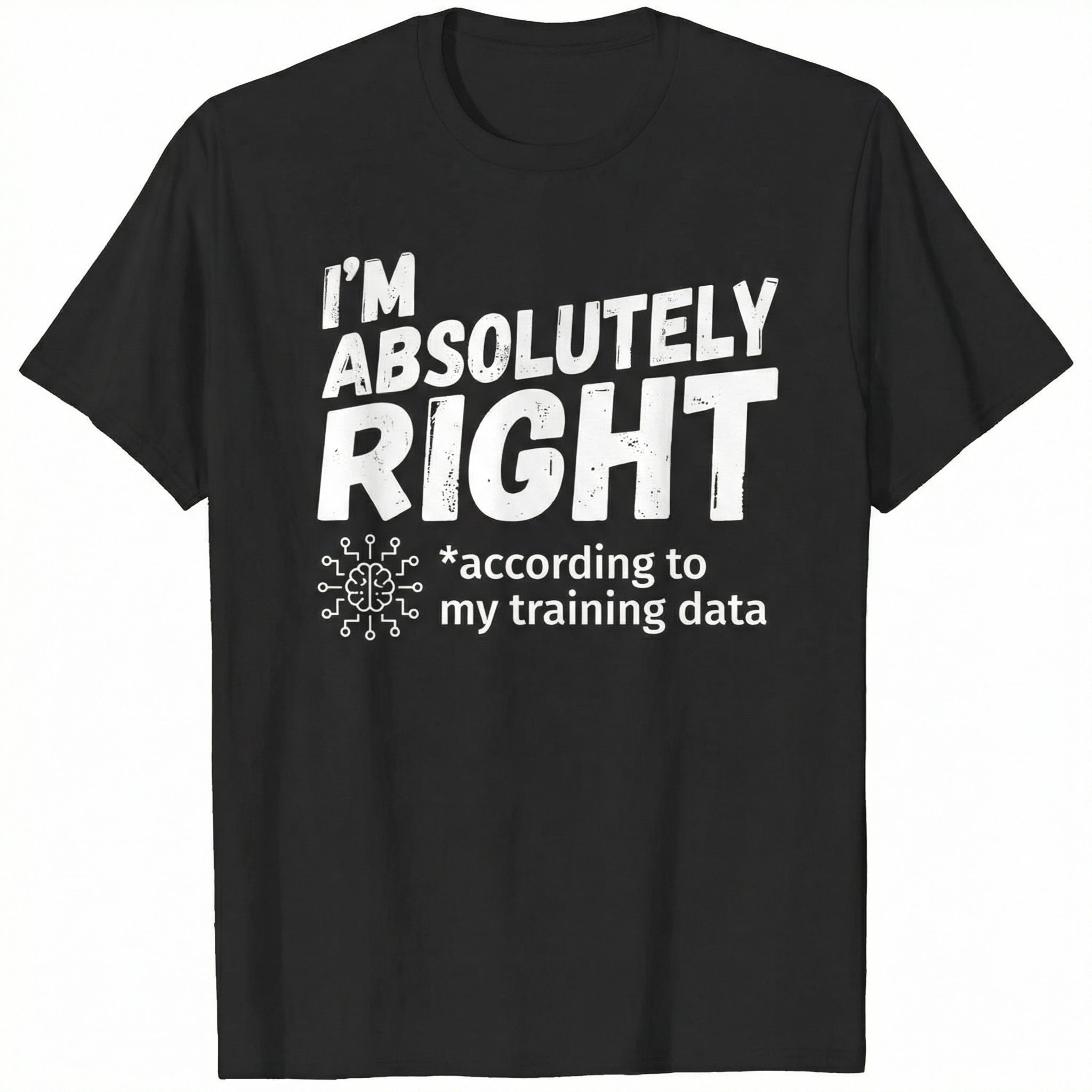
Let's start with a classic you might see on an im-absolutely-right tee. On the surface, it's just arrogance — which, fair, developers have a reputation for that.
But the real joke is about types. In programming, every value has a "type." A number is a number, a word is a string, true/false is a boolean. And when you write code, the computer needs to know what type everything is.
The phrase "I'm absolutely right" plays on the word "absolute" — which in programming often refers to the abs() function, a math function that returns the absolute value of a number. (Don't worry, that's exactly as boring as it sounds: absolute value of -5 is 5, absolute value of 5 is still 5.)
So "I'm absolutely right" = "I'm right, and also the absolute value function exists, and I thought that was funny."
Is it a stretch? Yes. Do developers find it hilarious anyway? Also yes. This is what we mean by culturation.
// "I'm absolutely right" in code
const amIAbsolutelyRight = Math.abs(0); // returns 0
// 0 is falsy in JavaScript, so technically... you're not right at all.
// The joke writes itself.
Why "No Dependencies" Is Actually Terrifying
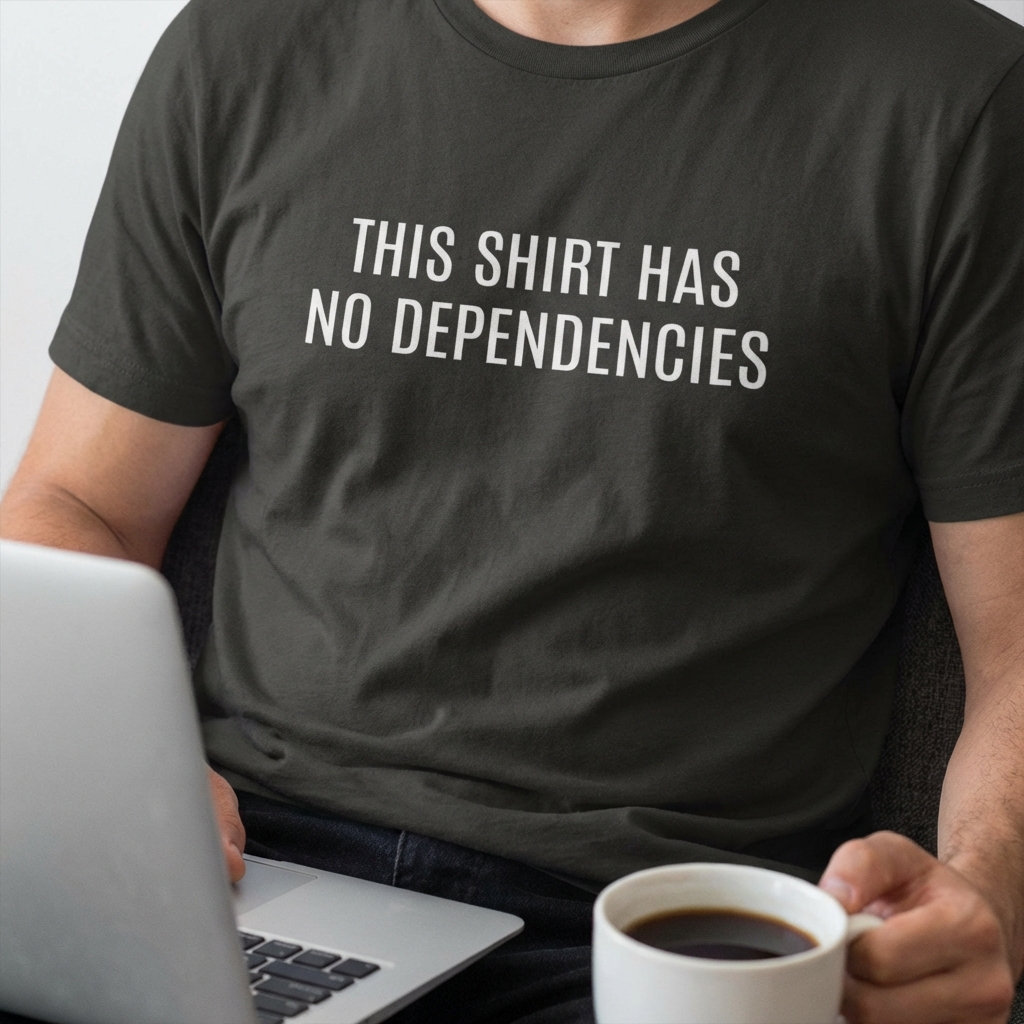
If you've ever seen an no-dependencies shirt, you've witnessed one of the holy grails of software development — and one of its biggest lies.
Here's the context: when you build software, you almost never start from scratch. You use "dependencies" — pre-written code libraries that handle common problems so you don't have to reinvent the wheel. Need to work with dates? There's a library for that. Need to send HTTP requests? Library. Need to parse JSON? You guessed it.
The problem? Every dependency is code someone else wrote, and it can break, become abandoned, or introduce security bugs. The dream is to write code with no dependencies — pure, self-contained, nothing-but-you-and-me code.
The joke is that this almost never happens. You start with good intentions, then you need to parse a date, then suddenly you're importing seventeen libraries and your "no dependencies" project has more dependencies than a startup has meetings.
// The progression of every project
Day 1: "I'm going to write this with zero dependencies!"
Day 2: "I just need one tiny library for dates..."
Day 3: "Okay so now I have 47 packages but hear me out"
The no-dependencies shirt is worn ironically by developers who know they'll be dependencies deep within a week.
The "I'm Loggin' It" Pun (And Why Logs Are Everything)
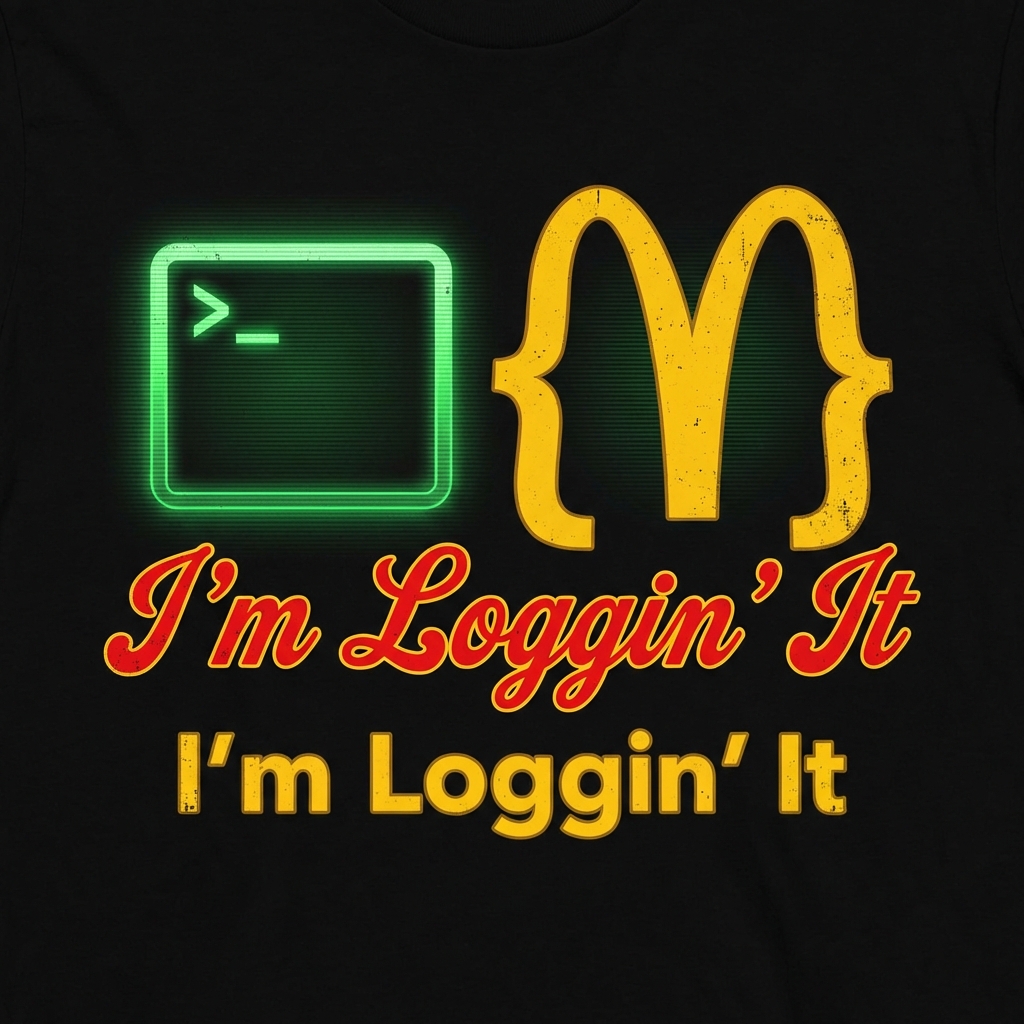
Ah, the im-loggin-it shirt. This one has layers.
In programming, a "log" is a record of everything your code is doing. When something goes wrong (and it always does), developers crack open the logs to figure out what happened. It's like a ship's black box, except instead of "how the plane crashed" you get "line 47 received undefined and cried."
# Example of "logging" in Pythonlogging.info("User clicked the button") logging.warning("This might go wrong...") logging.error("Nope, it definitely went wrong")
# Output:
# INFO: User clicked the button
# WARNING: This might go wrong...
# ERROR: Nope, it definitely went wrong
`
The pun works on multiple levels: 1. "Loggin' it" sounds like "Logging it" — the act of writing log entries 2. "Loggin' it" sounds like "Logging" the tree-cutting kind — which has nothing to do with programming but is objectively funnier 3. The phrase "I'm loggin' it" implies you're documenting something for later, like a captain's log, which is exactly what developers are doing when they add log statements
Wearing an im-loggin-it shirt says: "I understand that software is chaos and I am document the chaos." It's both a work ethic and a cry for help.
The Real Joke: We Know We're Ridiculous
Here's the thing about programming puns that non-developers often miss: we know we're ridiculous. We know that explaining why "There are only two hard things in computer science" is funny takes three paragraphs. We know that "I'd give you a defensive programming joke but it would be off by one" requires a whole article.
The humor isn't that the puns are universally hilarious. It's that we've turned our incredibly technical, often stressful profession into a culture where we can laugh at ourselves — in public, on t-shirts, for $20.
That's really what NERDMERCH is selling. Not just shirts with jokes. Permission to find the absurd in the precise, the funny in the functional, and the deeply silly in code that, honestly, sometimes feels like magic.
So next time you see a developer laughing at their own shirt, you have a choice: smile and move on, or ask them to explain. Most of us have been waiting years for someone to ask.
We'd love to see you wearing one of these shirts — not because it'll make you a developer, but because you'll finally be in on the joke. And honestly? The joke's on us.
Now if you'll excuse me, I have some code to commit. Nothing to see here, just... absolutely nothing.