Rubber Duck Debugging and Other Dev Rituals Worth Wearing
From rubber ducks to git commits, developers are a superstitious bunch. Here's how the rituals that keep us sane became worth wearing on a t-shirt.
There's a yellow rubber duck sitting on approximately 47% of developers' desks right now. Not because they collect rubber ducks. Not because they have a peculiar fondness for bath accessories. Because somewhere, someone told them that explaining their code line-by-line to an inanimate waterfowl would somehow fix a bug they'd been stuck on for three days.
And it worked.
Rubber duck debugging is the developer's equivalent of talking to a plant, except the plant actually helps you find the missing semicolon. The concept comes from the book "The Pragmatic Programmer" and it's become so ingrained in our culture that it's practically a job requirement. You don't need a computer science degree. You need a duck.
The Magic of Explaining Things to Objects
Here's the thing about rubber duck debugging that nobody talks about enough: it works not because of the duck, but because of the forced articulation. When you explain a problem out loud, you're forced to confront the gap between what you think your code does and what it actually does. That gap is where bugs live.
"So the function takes the user ID, and then it should... wait. Why would it do that?"This moment of realization—where your verbal explanation reveals the flaw—happens constantly with rubber ducks. The duck never gets tired of listening. The duck never interrupts. The duck never says "have you tried turning it off and on again?" The duck just sits there, being a duck, helping you think.
We've made t-shirts about this. Because of course we have. If you're going to anthropomorphize a bath toy for debugging purposes, you might as well represent.
The Holy Ritual of Git Commits
Every developer has opinions about git commit messages. Very strong opinions. The kind of opinions that have spawned wars, PR threads with 47 comments, and at least three meme accounts dedicated to documenting commit message crimes.
The ritual goes like this: you write code. The code works (somehow). Now you must describe what you did in a way that future-you will understand and past-you wishes you had done.
fix: resolve null pointer in user authentication
feat: add dark mode toggle that actually works
refactor: nobody touch this section, I barely understand it myself
The best developers treat commit messages like love letters to their future selves. The worst developers write "fixed stuff" and hope for the best. We've all been both at different points in our careers.
There's also the midnight deploy ritual. You know the one. You finish coding at 11:47 PM, you know you should wait until morning, but you also know that if you don't deploy it right now, you'll spend all night thinking about it. So you deploy. Then you spend all night thinking about it anyway, but now with the added thrill of watching error logs in real-time.
The Terminal Is a Lifestyle
If you've ever felt a strange sense of peace while staring at a terminal window, you might understand the appeal of our "terminal-illness" design. Terminal work isn't just a skill—it's a condition. You start seeing problems in terms of stdin and stdout. You catch yourself typing ls into non-terminal contexts. You know way too much about process management for someone who just wanted to rename 300 files.
# The universal terminal workflow
while true; do
  command_that_should_work
  if success; then
    break
  else
    add_more_logs()
    "I'm loggin it" becomes your battle cry
  fi
done
The "I'm loggin it" shirt isn't ironic. It's aspirational. Every senior developer has been in that meeting where someone asks why an error happened and you have to explain that the only evidence is a log file from three weeks ago that said "something went wrong." We log because we hope that someday, the logs will save us. They rarely do. But we keep logging.
The Caffeine-Code-Sleep Cycle
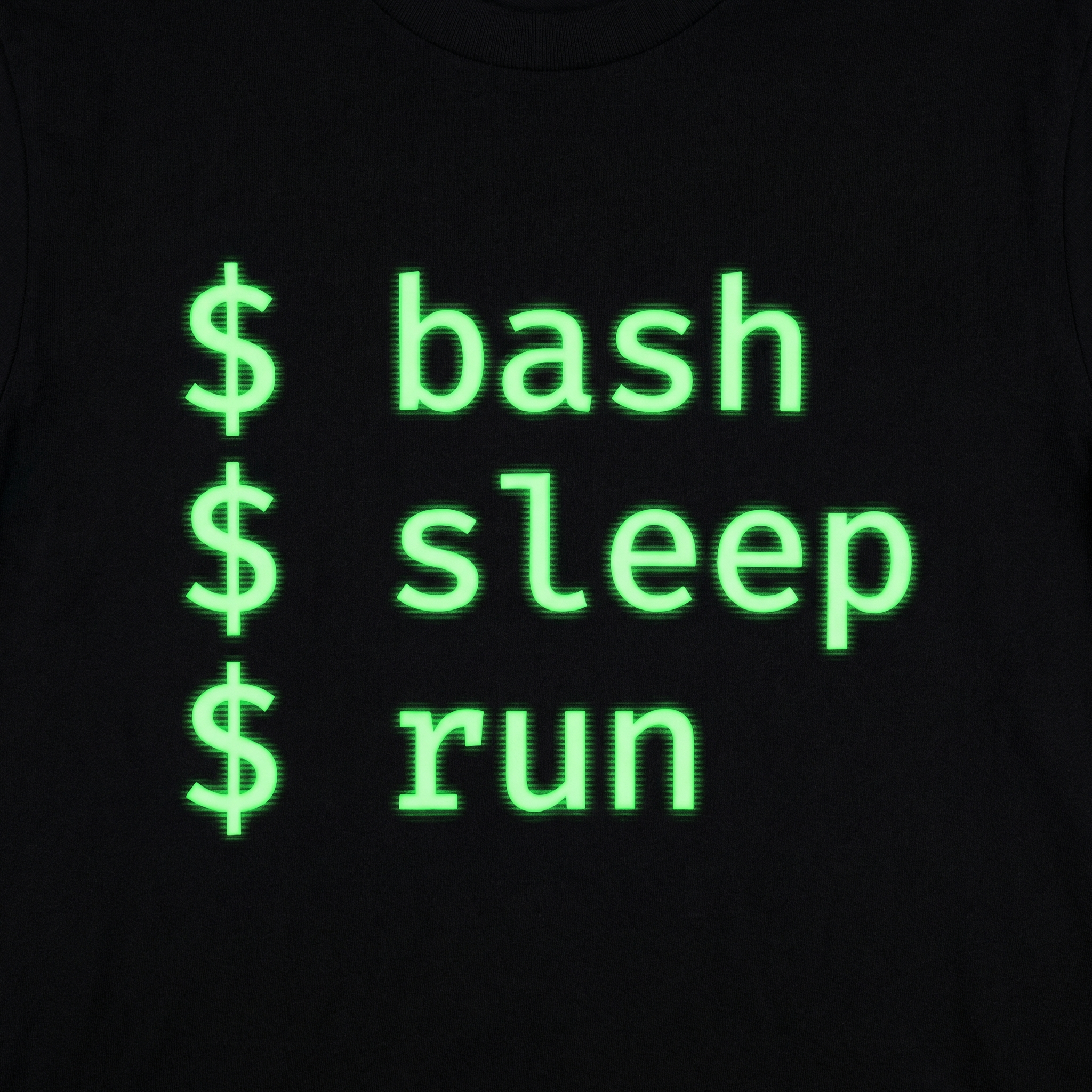
There exists in every developer a sacred, terrifying ritual known as the "bash-sleep-run" cycle. You code until you can't see. You sleep for four hours. You run the code expecting success. You get an error. You repeat.
#!/bin/bash
# The eternal struggle
for day in {1..forever}; do
  drink_coffee
  write_code
  if [[ $(date +%H) -lt 6 ]]; then
    echo "理性开始下降" # rationality declining
  fi
  if bug_count > 0; then
    sleep 4  # realistic sleep for devs
    continue
  fi
  deploy_with_fingers_crossed
done
This cycle is brutal and beautiful. It's how features get shipped at 3 AM. It's how we convince ourselves that we're close to a solution when we're actually three wrong turns deep in a forest of bad decisions. The bash-sleep-run shirt exists because someone finally named the thing we've all been doing involuntarily.
Rituals That Make Us Human
The truth about developer rituals is that they're not really about efficiency or productivity or any of the metrics we'd use in a sprint planning meeting. They're about maintaining sanity in a profession where you're constantly fighting against your own brain's tendency to assume things work the way you think they should.
The rubber duck forces you to slow down and articulate. The commit message ritual forces you to reflect on what you actually accomplished. The logging habit forces you to leave breadcrumbs for your future self. The caffeine-code-sleep cycle is... okay, that one's just survival.
But here's the beautiful part: these rituals are shared. They transcend company, language, and framework. Show up at any tech conference on Earth and mention rubber duck debugging, and at least three people will nod knowingly. These are our rituals. The developer equivalent of superstition at the craps table or always stepping on the same crack in the sidewalk.
Wearing your rituals is part of that shared identity. It's saying "I too have spent four hours debugging only to find the problem was a typo." It's belonging to a tribe that understands why a rubber duck on a desk is perfectly normal. It's knowing that somewhere out there, another developer is going through the exact same debugging nightmare at this exact moment, and that tomorrow, they'll laugh about it.
Or they'll buy a shirt about it. Same thing, really.