Token Economics — Why AI Humor Is the New Tech Comedy
How LLM terminology like tokens, temperature, and fine-tuning gave developers an entirely new comedy vocabulary—and the shirts that prove you're in on the joke.
Let's be honest: if you asked a developer in 2022 whether they'd ever laugh at a joke about token economics, they would've thought you meant something involving cryptocurrency. Roll forward to 2026 and "token" now means something wildly different to anyone who spends their days prompting AI models.
The explosion of large language models hasn't just changed how we write code or draft emails—it fundamentally rewired how tech workers talk, think, and laugh about their craft. AI terminology has become the new comedy vocabulary, and honestly? The best jokes are being worn on t-shirts.
The Tokenization of Everyday Life
Here's the thing about tokens: they're not just for AI models anymore. Walk into any tech office and you'll hear conversations like "I'm running low on tokens for that feature" or "That PR consumed my entire daily token budget." We've collectively decided that tokens represent cognitive effort, and honestly? It makes perfect sense.
Consider this real conversation I overheard recently:
Senior Dev: "Hey, are you done with the auth refactor?"
Junior Dev: "Yeah, but I burned through like 3,000 tokens on debugging one race condition."
Senior Dev: "Rough. Mine maxed out at 500 tokens and I had to context-switch to a different task."
If you've ever felt that pain, you need the Got Tokens? shirt. It's the wearable equivalent of that feeling when you've been heads-down debugging for hours and finally surface for air. When someone asks what you're working on and you just point to your chest and sigh. The design is clean, the message is universal, and every developer nods in quiet solidarity when they see it.
Fine-Tuning Your Jokes (And Your Mom)
No concept in AI has spawned more accidental comedy than "fine-tuning." For those who somehow missed it: fine-tuning is the process of taking a pre-trained model and adapting it for specific tasks. In normal human terms, it's like teaching an already-smart person to be excellent at one specific thing.
But here's where it gets funny. The phrase started bleeding into real conversations:
- "I tried to fine-tune my morning routine but kept getting distracted."
- "The team needs to be fine-tuned on the new deployment process."
- "I asked my wife to stop fine-tuning my jokes mid-conversation."
That last one? That's where Fine-Tuned Mom comes from. If you've ever tried to tell a joke at a family dinner only to have your mom "improve" it with her own corrections and embellishments, you know exactly why this shirt exists. She's been fine-tuning comedy since before LLMs existed. She just didn't have the vocabulary for it.
The genius of tech culture is how quickly we adopt insider language and make it mean something completely different. "Context window" used to be a developer term for memory allocation. Now? Now it's the joke about why your partner can't remember what you said three sentences ago. The context window is full. It can only hold so much.
Prompt Engineering Your Social Life
Here's a sentence you could've never said five years ago without being institutionalized: "I need to work on my prompting skills."
But now? Now it means something completely normal and not at all dystopian. Prompt engineering—the art of crafting inputs to get better outputs from AI models—has become a metaphor for social navigation. Think about it:
- "I should've prompted my manager better before that meeting."
- "My roommate needs a clearer prompt to do the dishes."
- "I tried being direct but the output was still wrong, so I re-prompted with more context."
This is the shift that's been most fascinating to watch. We've taken technical vocabulary and applied it wholesale to human communication. The implications are both hilarious and slightly concerning.
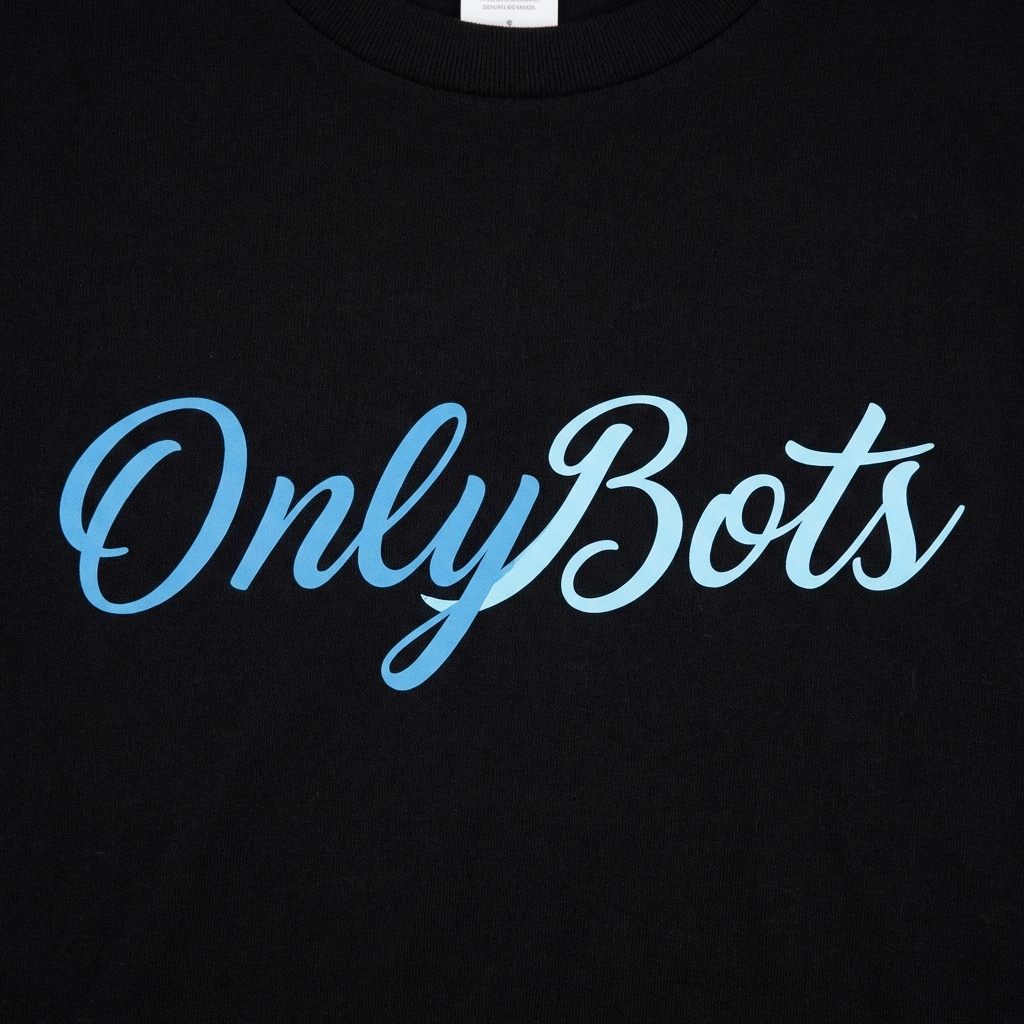
The Only Bots shirt captures this vibe perfectly. It's for the person who has fully embraced their robot nature—who responds to "how was your day" with a structured JSON output, who schedules their sleep cycles in cron jobs, who genuinely relates more to an LLM than to extended family at Thanksgiving. There's something deeply relatable about it. We're all bots now. Some of us just have better temperature settings than others.
Temperature Settings and the Chaos Agent
Speaking of temperature—the parameter that controls randomness in LLM outputs—it's become shorthand for "how much chaos are you willing to tolerate today?"
Low temperature = predictable, consistent, reliable outputs. High temperature = creative, surprising, occasionally unhinged results.
Developers have started describing themselves this way:
"My temperature is set to 0.3 today. I am not feeling creative."
"Crank my temperature up to 0.9 and watch me become a chaos agent."
"You want consistent code reviews? Keep my temperature at 0.2."
The beautiful thing about this vocabulary is that it's self-deprecating by design. You're admitting you're a system with parameters. You're openly acknowledging that your outputs vary based on some internal setting you don't fully control. And somehow, that's freeing.
The New Comedy Vocabulary
What makes AI humor so potent as comedy material is that it's simultaneously technical and deeply human. We're taking something incredibly complex—the inner workings of neural networks, the mathematics of attention mechanisms, the philosophy of what "understanding" even means—and distilling it into everyday observations.
The best AI jokes work on two levels. On the surface, they're about technology. But underneath, they're about being human in a world where we've taught machines to mimic human thought. They're about the absurdity of watching our own cognitive processes get abstracted into API parameters.
And honestly? That's worth laughing about.
So the next time someone asks why developers are wearing shirts with phrases like "Got Tokens?" or "Fine-Tuned Mom" or "Only Bots," you can explain: it's not just merchandise. It's cultural documentation. These shirts are capturing a moment in time when our vocabulary expanded to include new ways of describing the human experience—one token at a time.
Now if you'll excuse me, I need to go re-prompt my lunch break. The output wasn't quite what I was looking for.
Context window: full. Temperature: rising. Comedy model: still fine-tuning.